Rasyonet - Financial Data Tracker API & MVC Dashboard
📌 Project Purpose
This project is a complete ecosystem containing a RESTful Web API and a real-time MVC Dashboard designed for tracking personal financial portfolios and market watchlists. It was developed as part of the Rasyonet Software Engineering Internship Technical Assessment.
The application allows users to:
- Add assets (Stocks, Cryptos, etc.) with their quantity and average cost.
- Add assets to a "Watchlist" (Quantity = 0) to monitor target prices.
- Automatically fetch real-time prices from external financial markets in the background.
- Calculate total portfolio value and P&L (Profit/Loss).
- Generate "Radar Alarms" when an asset's market price approaches the user's target price.
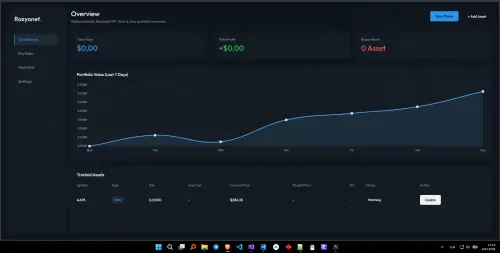
- View real-time updates seamlessly on a premium custom-styled web interface without manual refreshing.
🛠️ Technology Stack & Choices
- Backend Framework: .NET 10 Web API
- Frontend Framework: ASP.NET Core MVC (Razor Pages) with pure CSS (OKLCH Color Space)
- Language: C# 14
- Real-time Communication: SignalR
- Database: Microsoft SQL Server (via Entity Framework Core 10)
- Validation: FluentValidation
- Testing: xUnit
- API Documentation: Scalar OpenAPI (Modern UI natively supported in .NET 10)
- CI/CD: GitHub Actions with LFTP deployment to Plesk
📊 External API Choice: Finnhub
I chose Finnhub (finnhub.io) because it provides real-time quote data with a generous free tier (60 requests/minute). It seamlessly supports both standard stock tickers (e.g., AAPL) and cryptocurrency tickers (e.g., BINANCE:BTCUSDT), fitting perfectly with the polymorphic nature of the AssetType enum.
🌐 Live Demo
The application is deployed and publicly accessible:
- Dashboard (MVC): https://rasyonettask.barandasdemir.com
- API: https://api.rasyonettask.barandasdemir.com
🏗️ Architecture & Design Patterns
The project follows Clean Architecture principles, strictly separating concerns across layers (Controllers -> Services -> Repositories -> External Providers).
We also strictly follow the "Smart Backend, Dumb Frontend" philosophy. The MVC frontend contains zero business logic; it acts purely as a presentation layer that renders the pre-calculated view models supplied by the API.
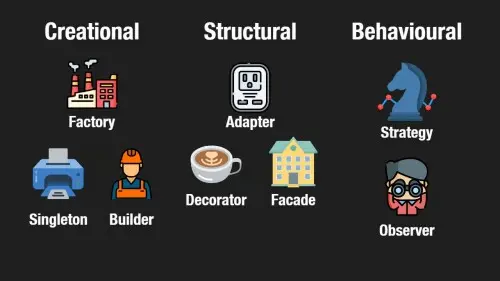
1. Strategy Pattern (IFinancialDataProvider)
Where: Services/External/FinnhubDataProvider.cs Why: The Strategy Pattern abstracts the implementation of fetching financial data. By depending on IFinancialDataProvider, the application is decoupled from Finnhub. If we migrate to Alpha Vantage tomorrow, we only need to implement a new class and change a single line in the DI container.
2. Repository Pattern (ITrackedAssetRepository)
Where: Repositories/TrackedAssetRepository.cs Why: It acts as a collection of domain objects in memory, abstracting the AppDbContext and EF Core specifics away from the Business layer (PortfolioService). This prevents database-specific code from leaking into the domain.
3. Observer Pattern (DashboardHub)
Where: Hubs/DashboardHub.cs & Services/PriceRefreshBackgroundService.cs Why: Used via SignalR to push real-time updates to connected clients. Instead of the browser constantly polling the server (which wastes resources), the BackgroundService acts as the Subject, notifying all connected Observers (browsers) exactly when new price data is fetched from Finnhub, prompting them to elegantly refresh their views.
⚖️ Trade-offs & Engineering Decisions
- Manual Mapping vs. AutoMapper: I deliberately chose to use Manual Mapping via Extension Methods (AssetMappingExtensions.cs) instead of AutoMapper. AutoMapper relies heavily on reflection, which impacts performance. Manual mapping provides compile-time safety and faster execution.
- Background Polling Rate: The PriceRefreshBackgroundService polls Finnhub every 60 seconds. This is a deliberate trade-off to respect Finnhub's free tier rate limit (60 req/min). In a production environment with a paid API, this could be reduced to milliseconds.
- Hardcoded Chart Data: The line chart on the dashboard currently uses sample data for visualization purposes. Since the database only collects snapshots while the application is running, generating a meaningful 7-day historical chart requires days of data collection. In a real-world scenario, this would be fueled by aggregating the PriceSnapshot table history.
- Hard Delete vs. Soft Delete: I implemented a "Hard Delete" for removing assets. Since this is a personal tracker, keeping clutter in the database is unnecessary. In a true enterprise banking system, I would have implemented a "Soft Delete" using EF Core Global Query Filters for audit trails.
🧪 Testing
The project includes meaningful Unit Tests targeting the core business logic.
- AssetMappingExtensionsTests: Verifies that the mathematical logic for calculating Profit/Loss (P&L), Total Value, and Target Proximity (Radar Alerts) works flawlessly independent of any database or external service.
🚀 How to Run (Docker)
The application is completely containerized for a seamless developer experience.
Prerequisites
- Docker Desktop installed and running.
- Git installed.
1. Clone the Repository
git clone https://github.com/barandasdemir0/RasyoFinanceTracker.git

cd RasyoFinanceTracker